
I. Introduction: The Boy Who Wanted the Easy Life
In the pantheon of Attack on Titan characters, where we are presented with vengeful demigods, genetically engineered super-soldiers, and royal masterminds capable of altering the memories of entire civilizations, Jean Kirschtein stands out for a singular, remarkable reason: he is aggressively, painfully mediocre.
When the 104th Training Corps is first introduced, the screen is populated by archetypal extremes that define the shonen genre. Eren Yeager is the burning manifestation of rage, a boy who views Titans solely as targets for extermination and operates with zero self-preservation instinct.
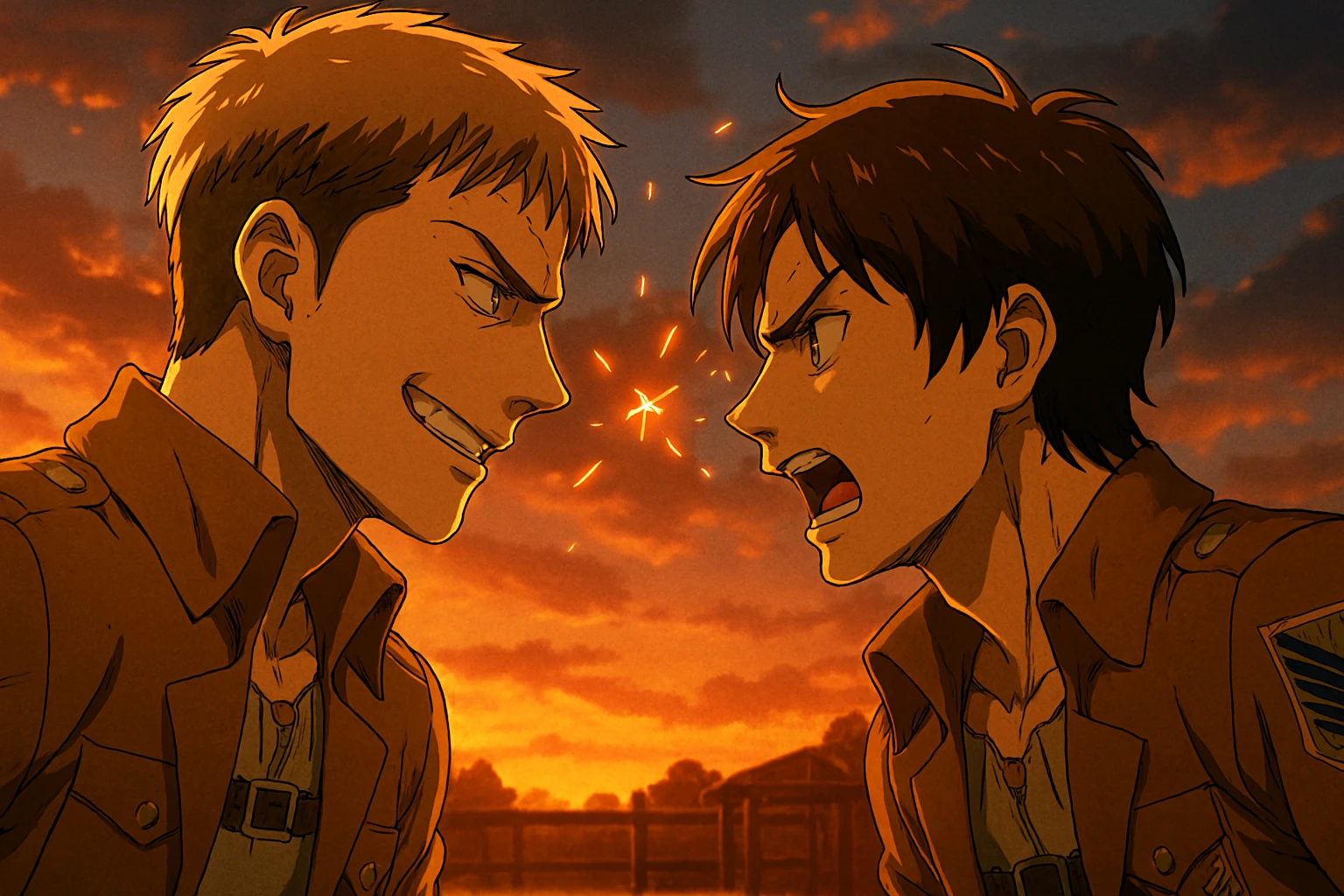
Mikasa Ackerman is a prodigy, a silent guardian with physical strength rivaling an entire platoon. Armin Arlert is the strategist, physically unassuming but mentally towering, capable of deconstructing complex political situations in seconds. Amidst these titans of character stands Jean—smug, cynical, self-interested, and normal.
This Jean Kirschtein character analysis begins not with a hero’s origin story, but with a confession of cowardice. Jean has no hidden Titan power, no tragic backstory involving the murder of his parents by the government, and no secret royal bloodline. He is the most important character for the audience to understand precisely because he lacks these special traits. He is the control group in an experiment of monsters.
The Hook: The Uncomfortable Mirror
Jean acts as the definitive audience surrogate. While consumers of fiction love to project themselves onto the heroes—imagining they would possess Levi’s stoicism or Erwin’s resolve—the uncomfortable reality is that the vast majority of us would be Jean.
His introduction is defined by a singular, selfish desire: safety. He joins the military not to fight for humanity’s freedom, but to escape the threat of the Titans entirely.
His goal is the Military Police Brigade—the prestigious inner-wall police force that allows its members to live in the safety of the Interior, far removed from the bloodshed of the frontier. He explicitly dreams of a life filled with expensive wine, soft beds, and boredom rather than the terror of being eaten alive. He is open about his desire to exploit the system for personal gain.
This desire for self-preservation is not villainous; it is human. In a world defined by the existential horror of being prey, wanting to survive is the most rational response. By establishing Jean as a cynic who mocks the idealistic fervor of his peers, Hajime Isayama creates a baseline for humanity.
Jean represents the status quo and the “bystander effect”—the instinct to run away from the fire, not toward it. He voices the doubts that the audience feels but is too afraid to admit: “Why should I throw my life away for a losing cause?”
The Thesis: Nature vs. Nurture
Jean’s narrative arc serves as the series’ definitive argument for “Nurture” triumphing over “Nature.” Eren Yeager was born with a nature that drove him toward conflict; he required no instruction on how to be brave because his lack of fear was a default setting. Eren was a slave to his own drive for freedom from the moment he was born.
Jean, conversely, had to dismantle his entire personality to become a hero. He is a coward by nature and selfish by instinct. Every heroic action he takes throughout the series is a deliberate, agonizing rebellion against his own DNA.
He is not a hero because it comes easily; he is a hero because it is difficult. He has to wake up every morning and actively choose not to run away.
To follow Jean’s path is to watch a man terrified of dying slowly realize that there are fates worse than death. It is the story of a boy who wanted the easy life realizing that a comfort built on the suffering of others is a life not worth living.
He becomes the series’ best leader not through strength, but by learning, through blood and trauma, how to manufacture bravery from the raw materials of fear.
The Contrast: The Realist vs. The Idealist
The dynamic between Jean and Eren is often framed as a rivalry, but it is more accurately a dialectic collision between Idealism and Realism.
Eren represents the Idealist, operating on abstract concepts of Freedom, Hate, and Revenge. He is willing to burn the world down to achieve a philosophical victory, rushing into battle without checking his gas levels because his rage acts as propulsion. He sees the world as it should be (or as he demands it to be).
Jean represents the Realist, operating on concrete facts: Logistics, Survival, and Risk. He criticizes Eren not merely to be an antagonist, but because Eren’s reckless behavior objectively endangers the unit. Jean calculates the odds. He values his life and the lives of those around him. He sees the world as it is.
This friction is essential. Without Eren, the story would never move forward—humanity would have remained paralyzed behind the walls, waiting to be consumed. But without Jean, the story would have burned out in Season 1.
Jean anchors the narrative in reality, constantly reminding the audience that war is not glorious; it is messy, terrifying, and usually ends with good people dying for nothing. Jean is the tether that keeps Eren’s balloon from floating away into total abstraction.
II. The Ashes of the Dead: The Moment Childhood Died
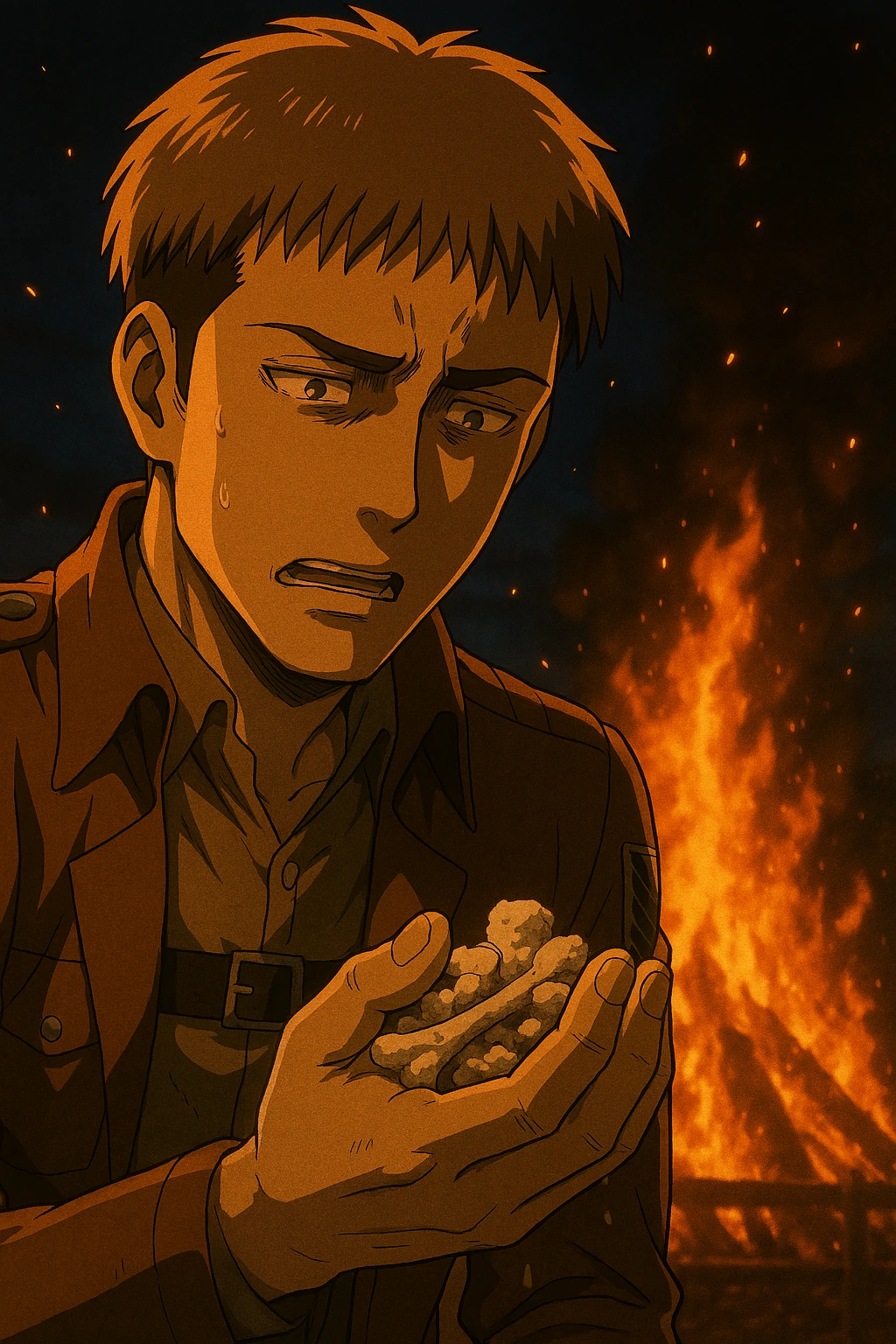
Character development in Attack on Titan rarely happens during training montages. It occurs in the quiet, horrific aftermath of violence. For Jean Kirschtein, the death of his childhood didn’t happen in the heat of battle; it happened in a side alley in Trost, staring at a pile of bones.
The Catalyst: Marco Bodt
To analyze Jean’s growth, one must understand Marco Bodt. Marco was not just a friend; he was Jean’s moral compass and external conscience.
He was the only person in the 104th who saw past Jean’s prickly, arrogant exterior to the capability beneath, often noting that Jean’s honesty made him trustworthy. Marco saw that Jean’s cynicism was actually just a defense mechanism for a person who cared too much.
During the Battle of Trost, the cadets are thrown into a meat grinder. The realities of Titan combat shatter their training. When the dust settles, Jean survives, proving his competence with 3D maneuver gear. But survival in this world always exacts a toll.
Jean finds Marco’s body days later during the cleanup operation. Isayama avoids a tearful goodbye, opting instead for a forensic discovery. Jean finds a corpse slumped against a wall, half of its face missing, unrecognizable to anyone who didn’t know him intimately. There were no last words. There was no glory. Just meat and silence.
The Bone Scene: A Visual Autopsy of Trauma
This scene is the critical pivot point in Jean’s life. Tasked with identifying bodies before they are burned to prevent the spread of disease, Jean stands before a communal pyre. As the fire consumes the dead, the bodies break down into indistinguishable ash and bone.
Jean looks at the bone fragments in his hand and realizes he cannot tell which ones belong to his friend. In the fire, the brave and the cowardly, the strong and the weak, the rich and the poor—they all become the same charred carbon. This anonymity of death terrifies Jean more than the Titans do. It strikes at the heart of his ego.
If he were to follow his original plan—to join the Military Police and hide in the Interior—Marco’s death would become a statistic.
Marco would be just another set of bones in the pile, forgotten by history. Jean realizes that the only way to give Marco’s life meaning is to carry his memory forward into the fight. He cannot let his friend’s existence be erased by the apathy of the living. He realizes that the dead only have the meaning the living assign to them.
The Choice: Rejecting the Interior
The internal monologue that follows marks the death of the “old” Jean. He is terrified. His hands shake. He knows that joining the Survey Corps (the Scouts) is essentially a death sentence. The casualty rate is nearly 100%.
Yet, he joins. He doesn’t do so because he suddenly believes he is a hero or because he wants to save the world. He joins because he cannot live with the shame of safety. He acknowledges that he lacks Eren’s conviction—he explicitly states, “I’m not like him”—but the thought of those bones burning in vain forces his hand.
This distinction is vital. Eren fights for the future—a hypothetical world where he is free. Jean fights for the past—to honor the dead who can no longer fight for themselves. This choice transforms Jean from a selfish boy into a reluctant soldier.
He accepts the burden of the Survey Corps out of a terrifying sense of obligation. It is the moment the Realist accepts that reality is worth fighting for, even if the odds are impossible.
III. Leading from the Middle: Understanding Weakness
Great leaders in fiction are often portrayed as fearless paragons of virtue, charismatic generals who ride at the front of the charge. Attack on Titan deconstructs this trope by presenting Jean Kirschtein as the ideal leader specifically because he is flawed.
Leadership Analysis: The Logic of Weakness
Marco’s assessment of Jean remains the core thesis of his leadership style. He explicitly praised Jean not for his strength, but for his weakness. He argued that because Jean is not a prodigy, and because he knows what it is to be afraid, he can understand the fears of the average soldier. This empathy allows him to make decisions that save lives, rather than treating soldiers as disposable pawns.
This creates a profound paradox. Commanders like Erwin Smith or Levi Ackerman operate on a plane of existence that the average soldier cannot comprehend. Erwin is willing to sacrifice hundreds of lives for a singular truth; he views soldiers as variables in a calculus equation. Levi is so physically dominant that he often struggles to understand why others fail or die.
Jean, however, feels the trembling in his knees. He knows the urge to vomit before a battle. Because of this, when he commands soldiers, he is guiding people who are just as scared as he is. He speaks their language. He assesses risk based on the value of human life, not just the mission objective.
Case Study A: Order from Chaos in Shiganshina
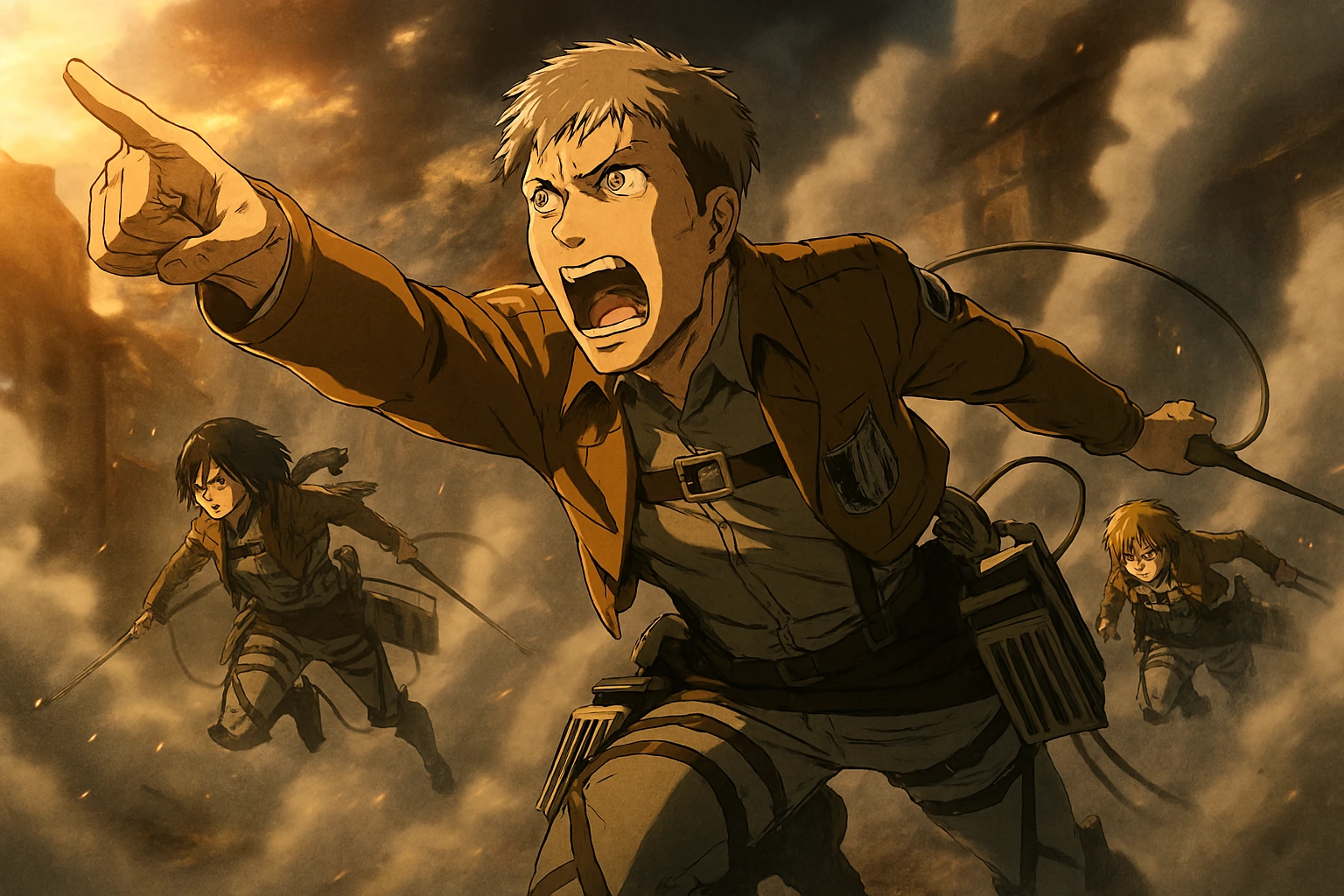
Jean’s leadership capabilities are fully realized during the Return to Shiganshina arc. The situation is catastrophic: The Beast Titan has wiped out the veteran support, and the Colossal Titan (Bertolt) is decimating Shiganshina. The squad—comprising Mikasa, Armin, Sasha, and Connie—is pinned down and paralyzed.
Armin, the designated tactician and genius, freezes under the immense pressure of the situation. He cannot see a path to victory. Jean steps up. He does not take command because he craves power; he takes it because the vacuum needs to be filled. He turns to Armin and says, “You come up with the plan. I’ll make the calls.”
This distinction is brilliant leadership. Jean recognizes his own limitations—he knows he isn’t as smart as Armin. But he also recognizes that Armin is paralyzed by the responsibility of decision-making. Jean takes the burden of responsibility (the “calls”) off Armin’s shoulders, freeing the tactician to think.
He then leads a suicide charge to distract the Armored Titan (Reiner). He coordinates the use of the new Thunder Spears. He commands soldiers who are objectively stronger (Mikasa) and smarter (Armin) than him because he maintains the clearest head in the crisis. He manages the fear of the group, keeping them moving when every instinct screamed at them to give up.
Case Study B: Restraint Amidst Rage in Liberio
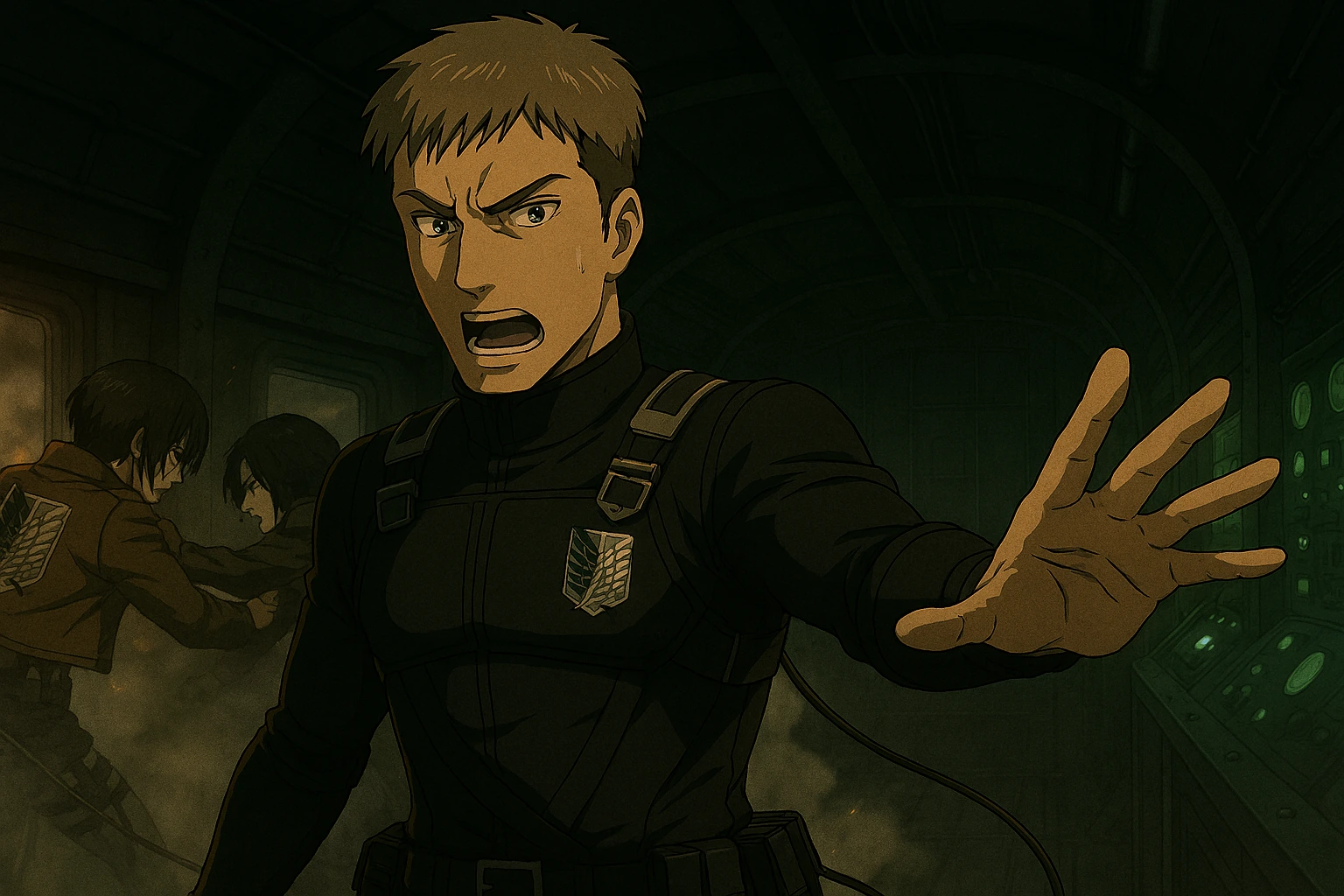
By Season 4, during the Raid on Liberio, Jean functions as the de-facto Field Commander. The Survey Corps has changed; they are no longer the underdog defenders, but invaders wearing black, utilizing anti-personnel gear. The morality has shifted into grey.
While Eren rampages as the Attack Titan and Floch incites the Yeagerists to burn civilian homes, Jean acts as the stabilizing moral force. He focuses strictly on the objective: crippling the Marleyan military and extracting his team. He barks orders to minimize civilian casualties, not out of naive idealism, but out of disciplined professionalism.
When Floch attempts to execute the child soldiers Gabi and Falco by throwing them out of the airship, Jean intervenes. He argues that killing children only perpetuates the cycle of violence that trapped them in this war in the first place.
Even in the heart of enemy territory, Jean retains his humanity. He refuses to become a monster to fight monsters. This ability to maintain a moral center while executing lethal violence is what makes him the series’ best leader. He is the bridge between the pragmatism of the military and the idealism of the human spirit.
IV. The Mirror of Radicalism: Jean vs. Floch
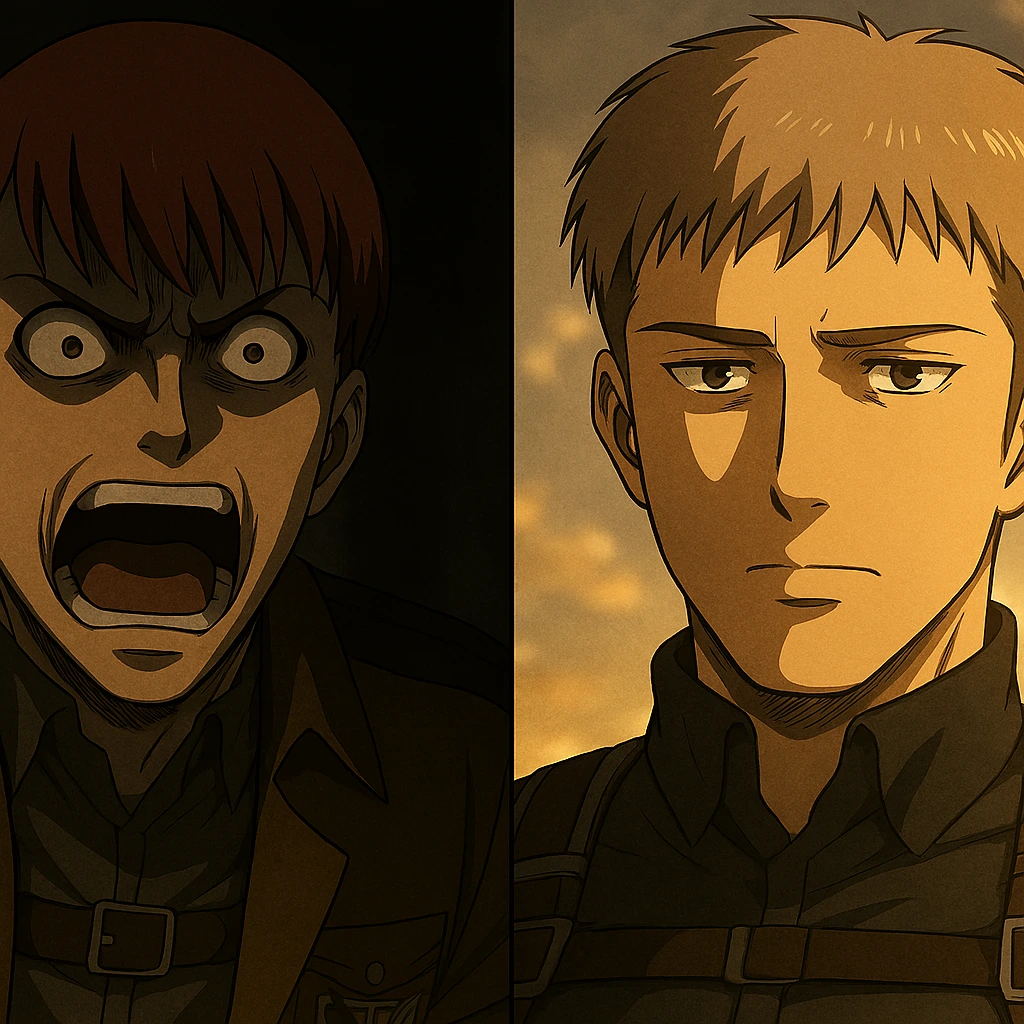
To truly understand Jean’s character depth, we must compare him to his dark reflection: Floch Forster. Both characters begin their arcs as cowards. Both are terrified “red shirts” who survive the suicide charge against the Beast Titan in Shiganshina. Both are traumatized by the realization of their own powerlessness.
However, their reactions to this trauma diverge completely, creating two opposing archetypes of “The Normal Man.”
Floch: The Coward Who Sought a Devil
Floch reacts to his fear by seeking an external authority to submit to. He cannot handle the weight of his own agency. Initially, he latches onto Erwin Smith, believing that only a “devil” can destroy the Titans. When Erwin dies, Floch transfers this fanaticism to Eren Yeager.
Floch finds courage by abandoning his own morality and fully submitting to a radical ideology. He becomes a fascist because it makes him feel safe; if he is on the side of the “Devil,” he doesn’t have to be afraid anymore.
Jean: The Coward Who Found Himself
Jean reacts to his fear by looking inward. He refuses to submit to blind ideology. He questions Erwin. He questions Eren. He questions the Yeagerists. Jean finds courage not by becoming a fanatic, but by accepting his own weakness and choosing to do the right thing despite it.
While Floch executes dissenters and burns civilians to prove his strength, Jean spares enemies and questions the morality of the Rumbling.
Floch represents what Jean could have become if he had let his fear turn into hatred. Jean represents the triumph of individual conscience over mob mentality. The contrast emphasizes that “being normal” doesn’t mean you have to be a follower; you can be a normal person and still stand against the tide.
V. The Rivalry: The Anchor to Eren’s Chaos
The relationship between Jean and Eren is the spine of the 104th Training Corps. It evolves from a petty schoolyard rivalry—fueled by Jean’s jealousy of Eren’s closeness to Mikasa and Eren’s annoyance with Jean’s cynicism—into a complex brotherhood defined by mutual respect and philosophical opposition.
The Inverted Rival
In standard shonen anime (like Naruto or My Hero Academia), the rival exists to challenge the hero physically, pushing them to get stronger. Jean does not serve this function; he rarely beats Eren in a fight and cannot compete with the god-like power of the Titans. Instead, Jean acts as the Psychological Anchor.
While the rival usually tries to defeat the hero, Jean’s role is often to stop the hero from making catastrophic mistakes.
As the story progresses, Jean becomes the primary interpreter of Eren’s actions to the rest of the group. When others panic or blindly defend Eren, Jean analyzes him. He understands Eren’s drive even if he despises his methods.
The Forest Scene: Breaking the Cycle
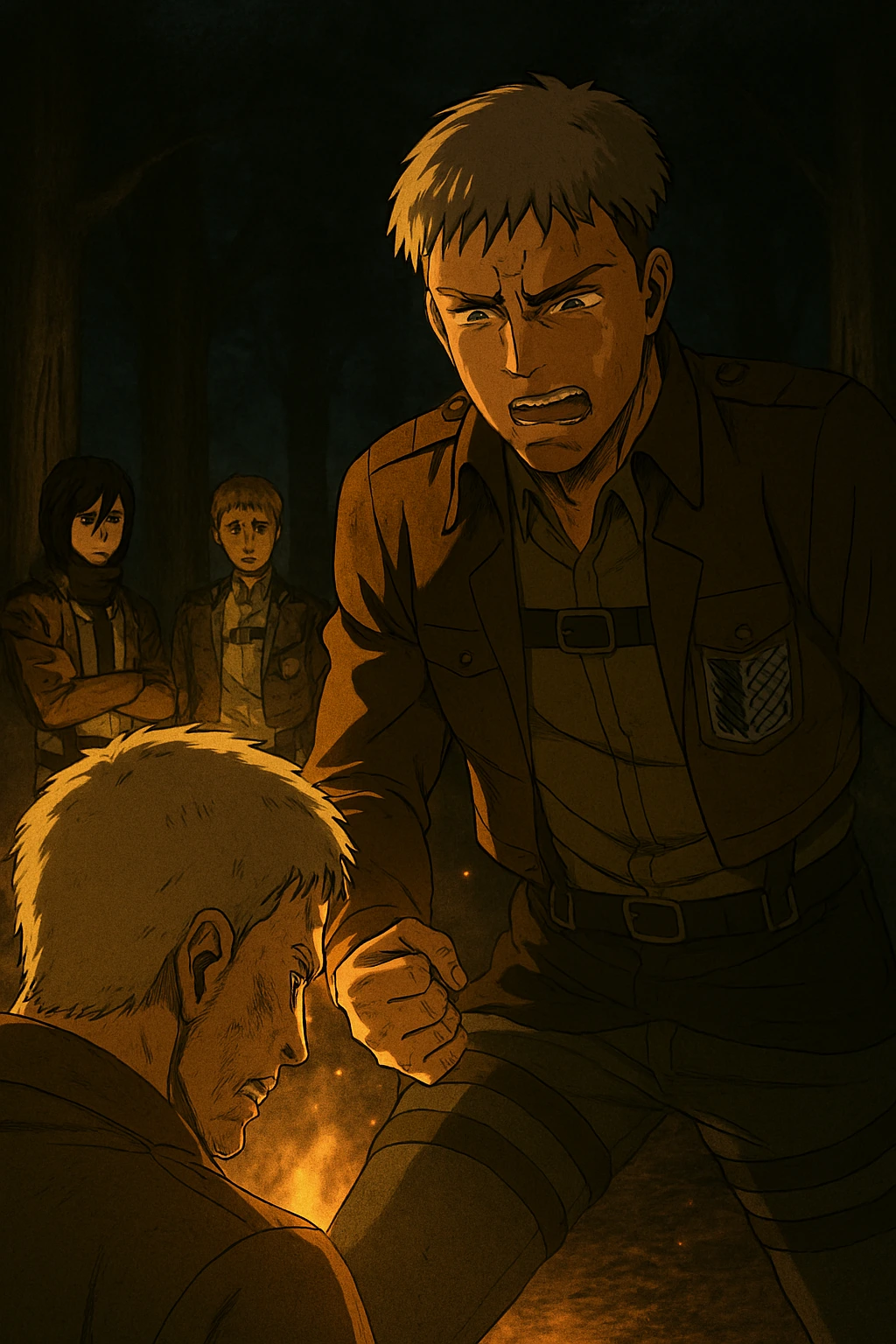
One of the most powerful scenes in the final season occurs around a campfire in the woods, where the remaining Scouts and the Marleyan Warriors form a desperate alliance. The truth about Marco’s death is finally revealed: Reiner admits to watching Marco die and forcing Annie to participate.
The revelation breaks Jean. The trauma of the “bone scene” resurfaces. He asks the question that has haunted him for years: “Did he have any last words?” Reiner replies, “He said we hadn’t had a chance to talk this through.”
Jean lunges. He beats Reiner into the ground. His fists embody years of repressed grief, confusion, and betrayal. It is a moment of pure, unadulterated rage. It is the moment where Jean could have killed Reiner.
But then… he stops. He kicks Gabi (accidentally/reflexively as she shields Reiner) and is horrified by his own violence. He walks away into the woods. Jean realizes that beating Reiner to death will not bring Marco back. It will not save Paradis.
It will only add more blood to the forest floor. Jean chooses to absorb the pain rather than propagate it. Unlike Eren, who seeks to resolve conflict by destroying the world, or Gabi, who sought to kill “devils,” Jean breaks the cycle by refusing to take the final step of vengeance.
He understands that justice and revenge are distinct concepts, and in this world, revenge is a luxury they cannot afford.
Defending Humanity in the Face of Genocide
Even after Eren initiates the Rumbling, Jean acts as the voice of reason within the Alliance. When Hange and Mikasa condemn the genocide on moral grounds, Jean plays Devil’s Advocate.
He forces them to acknowledge the dark truth: the Rumbling, while horrific, is the only guarantee of their immediate safety.
“Eren is doing this to protect us. To protect Paradis. If we stop him, the world will come for us eventually.”
Jean refuses to let the Alliance play the role of righteous heroes without acknowledging that their heroism might doom their own people.
This is the peak of the Realist. He looks the apocalypse in the eye and refuses to blink, demanding that his comrades understand the full weight of their choice to save the world at the expense of their own island.
VI. The Final Test: Giving Up the Dream Again
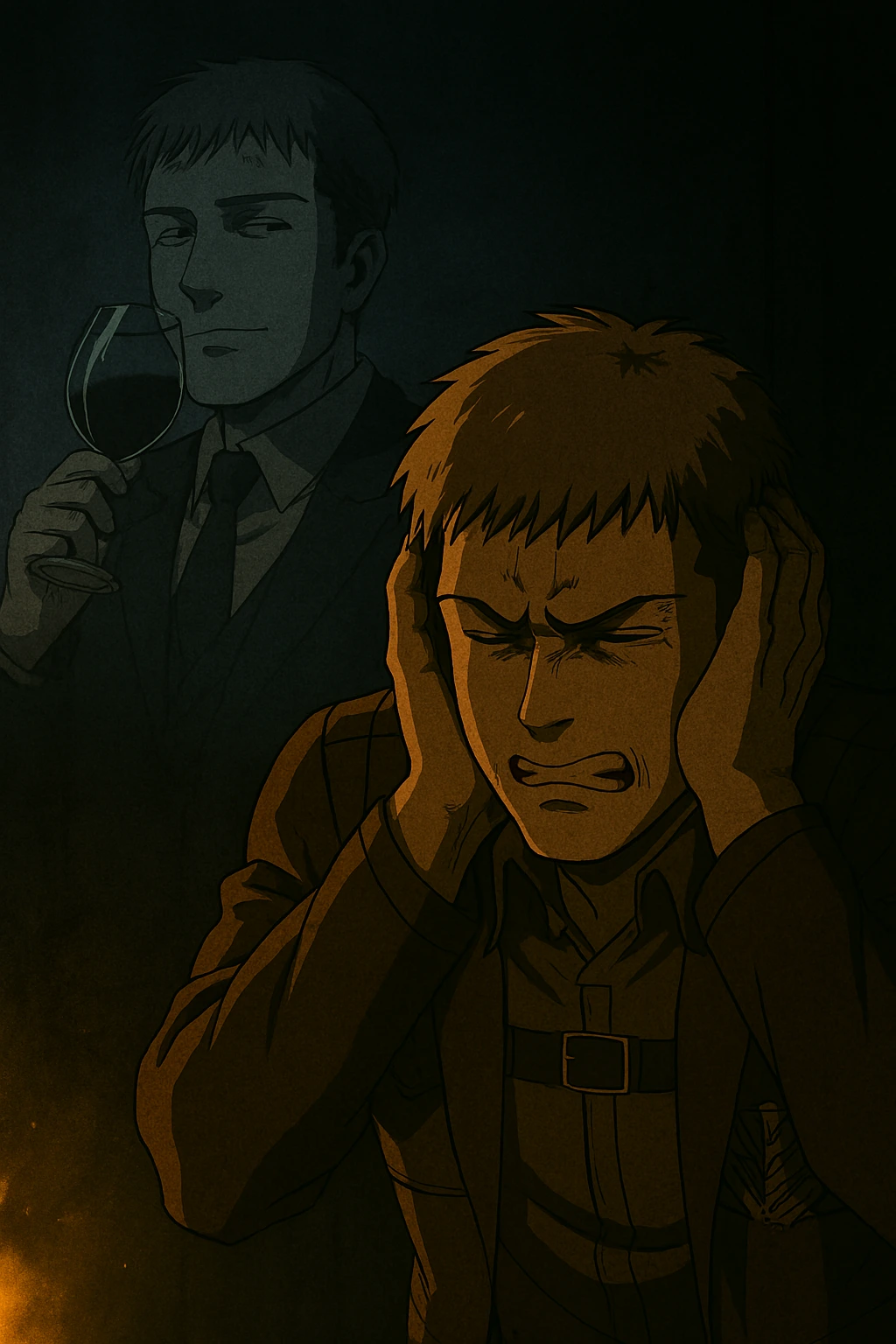
The beauty of Jean’s arc is its circularity. It begins with a boy who wants a comfortable life in the Interior, and it ends with a man who is offered that exact life, free of charge, and rejects it for the second time.
The Hallucination: The “Jean-bo” Dream
As the Rumbling begins and the Yeagerists seize control, the average Eldian on Paradis faces a moment of victory. The threat of Marley is gone. Jean finds himself alone in a room, and the narrative presents a vivid vision of his deepest desire fulfilled.
We see a flash-forward. Jean is older, sporting a beard, dressed in a fine suit. He stands on a balcony in the Interior, overlooking a peaceful, prosperous city. He holds a glass of expensive wine, savoring the bouquet. Inside, a beautiful wife and child are waiting for him. The lighting is warm, golden, and safe.
This is the life he fought for. This is the life he joined the military to achieve. All he has to do to make this dream a reality is… nothing. He just has to stay in his room. He just has to let Eren trample the world. He just has to let the Yeagerists win. The temptation is biblical in its scale. It is the temptation of apathy.
The Decision: Hell over Heaven
The scene where Hange recruits him for the Alliance is Jean’s final exam. He covers his ears. He squeezes his eyes shut.
“I just want to stay in my room with my ears covered!”
He screams internally, begging the universe to let him be selfish just this once. He has fought enough. He has bled enough. Hasn’t he earned the right to survive?
But he uncovers them. He opens the window to the night air.
He does so because of the bones. Jean realizes that the “good life” he dreamed of is tainted; if he drinks that fine wine, it will taste like ash. If he sleeps in that soft bed, he will see the faces of the people being trampled by the Wall Titans.
He has developed a conscience that is louder than his fear. He realizes that a life of comfort built on the genocide of the outside world is a life he cannot stomach.
Effort Triumphs
He chooses to join the Alliance—a suicide mission to fight the Founding Titan, a god-like being. He chooses to become a traitor to his own island to save humanity beyond the sea. He swaps the “Heaven” of ignorance for the “Hell” of battle one last time.
This decision is arguably more heroic than anything Eren ever did. Eren was compelled by destiny, by the future memories of the Attack Titan, and by a slave-like devotion to his own concept of freedom. Jean was free. He was truly free to choose safety. And he chose danger. That is true agency. That is true freedom.
VII. Conclusion: The Unsung Hero of Paradis
Jean Kirschtein ends the series not as the Commander of the Survey Corps, but as its enduring spirit. He is the survivor, the chronicler, and the man who lived to tell the tale.
The Verdict: The Gold Standard of Character Writing
Jean represents the gold standard of character writing in Attack on Titan. While Eren is a study in tragedy and determinism, Jean is a study in humanity. He proves that one does not need to be special to make a difference. You don’t need a bloodline. You don’t need a prophecy.
Jean is a testament to the power of showing up. He showed up when he was scared. He showed up when he was weak. He showed up when he wanted to run away. He represents the idea that bravery is not the absence of fear, but the mastery of it.
The Definitive Everyman Hero
Ultimately, Jean is the series’ true “Everyman Hero.” He is not a chosen one, a genius, or a super-soldier. He represents the average person’s struggle against overwhelming odds. His heroism is accessible because it is forged in doubt. We can’t all be Levi, spinning through the air and slicing beasts.
We can’t all be Erwin, leading charges into hell with a smile. But we can all be Jean. We can all choose to uncover our ears when the world is screaming.
In the final scenes of the manga and anime, we see Jean adjusting his tie, preparing for peace talks as an ambassador for the Allied Nations. He is exhausted, but he is standing. He has become a man who carries the weight of the world with a wry smile.
In a story full of monsters, gods, devils, and martyrs, Jean Kirschtein achieved something far more impressive: he remained a decent man.
If Attack on Titan asks us “What does it mean to be free?”, Jean answers: “It means choosing the hard right over the easy wrong.”
Jean Kirschtein showed us that the most heroic thing a person can do is look at the fire, acknowledge the fear, and step into it anyway. He is the Commander the world didn’t deserve, but the one it desperately needed.